Image

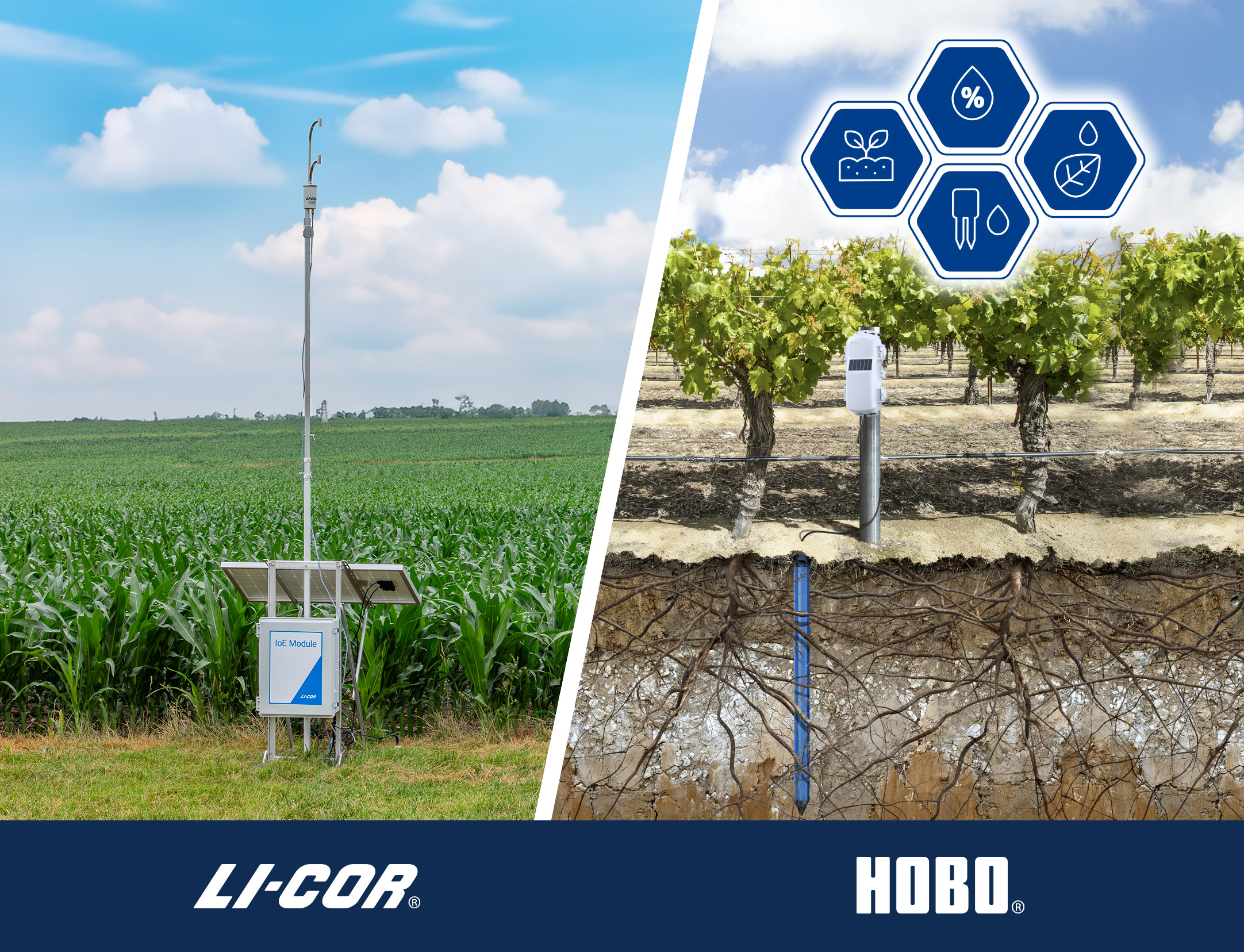
Our specialty crop and agricultural research customers need to understand growing conditions at a deep level. In the face of water scarcity and climate change impacts, they need information from not simply a single location– but across the whole field to get the data they need to make informed decisions. Combining environmental monitoring tools can scale their monitoring efforts, aggregating and amplifying the value of individual measurements to paint an accurate, comprehensive data picture they can use for analysis and decision-making. The benefits of this scaled, accurate perspective are bountiful, from cost-savings and water conservation to improved crop health and increased yields.
A clear example of this agricultural monitoring synergy—broader scale with enhanced accuracy—is the combined solution from LI-COR Environmental and HOBO Data Loggers.
When it comes to water management in agriculture, there is perhaps no more important measurement than evapotranspiration (ET)–the measurement of water loss from soil and plants due to evaporation and transpiration, respectively.
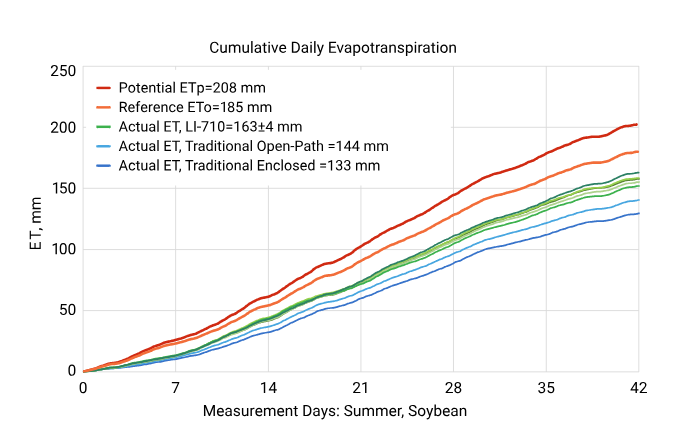
A common, often more cost-effective method for quantifying ET is calculating reference ET (ETo) or potential ET (ETp) using a formula, usually the more accurate Penman-Monteith equation. Potential ET calculations rely on a basic cluster of sensors: temperature, humidity, wind speed, and solar radiation. Unfortunately, these formulaic calculations commonly overestimate the amount of water lost to the atmosphere, as they often fail to account for the local conditions, including soil moisture, plant health and stage of growth. Reference ET often uses a “crop coefficient” to scale the overestimation down to a more accurate ET, but this single-value approach inherently fails to capture the dynamic nature of site conditions. In comparison, actual ET (ETa) is a direct measurement of ET at a specific location, responding to the unique site conditions present, including the availability of water that could transpire, the conditions within the soil, and at the surface. Actual ET incorporates the actual state of the environment, both living and nonliving. The eddy covariance method is the scientifically validated standard for measuring actual evapotranspiration in this manner. However, the method has traditionally been a high-cost and complex undertaking for the research community, in particular.
Enter a new, more affordable industry solution: The Water Node from LI-COR Environmental, a single sensor that streamlines the measurement of real-time actual evapotranspiration on-site by applying the eddy covariance method and measuring vertical wind and water content. The Water Node provides fully processed results every 30 minutes and integrates with an Internet of the Environment (IoE) module that transmits data to LI-COR Cloud software for analysis and sharing.
Growers can form an even clearer picture of this actual ET by integrating external parameters. For example, when you combine soil moisture measurements—direct measurements of the amount of water available to plants within this soil—with the measurement of actual evapotranspiration, you have an increasingly accurate picture of the environment’s water budget. Using both ET and soil moisture measurements, you understand the water availability to plants in the soil and the water loss to the atmosphere through the combination of evaporation and transpiration. Distributed measurements of soil moisture that come from a network of soil moisture sensors, in conjunction with actual evapotranspiration, can provide an opportunity to upscale monitoring across broader spatial regions. This is possible using the high accuracy and temporal resolution of ET provided by the Water Node, and the higher spatial coverage of the distributed soil moisture sensors – a proxy for actual ET across space.
Whole field monitoring solutions like these can deliver countless benefits:
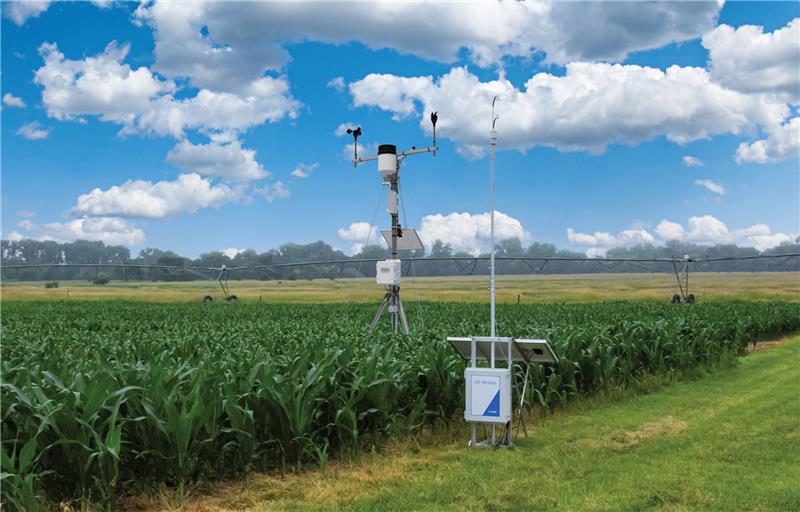
HOBOnet wireless sensor networks are a scalable solution that can provide researchers and growers accurate microclimate and conditions measurements across their whole field. Currently, soil conditions data from HOBOnet can be leveraged within LI-COR Cloud software to refine actual ET measurements from the Water Node. In the future, growers will be able to access both the Water Node and HOBOnet data in LI-COR Cloud, a centralized location where you can store, analyze and share your data anytime, from anywhere. This offers users streamlined access to their data and enhanced ability to collaborate and make decisions in real time. Stay tuned for this exciting development of the next generation of LI-COR Environmental and HOBO Data Loggers solutions!
[Written by: Taylor Thomas, LI-COR Product Manager and Alyce Pearce, HOBO Data Loggers]