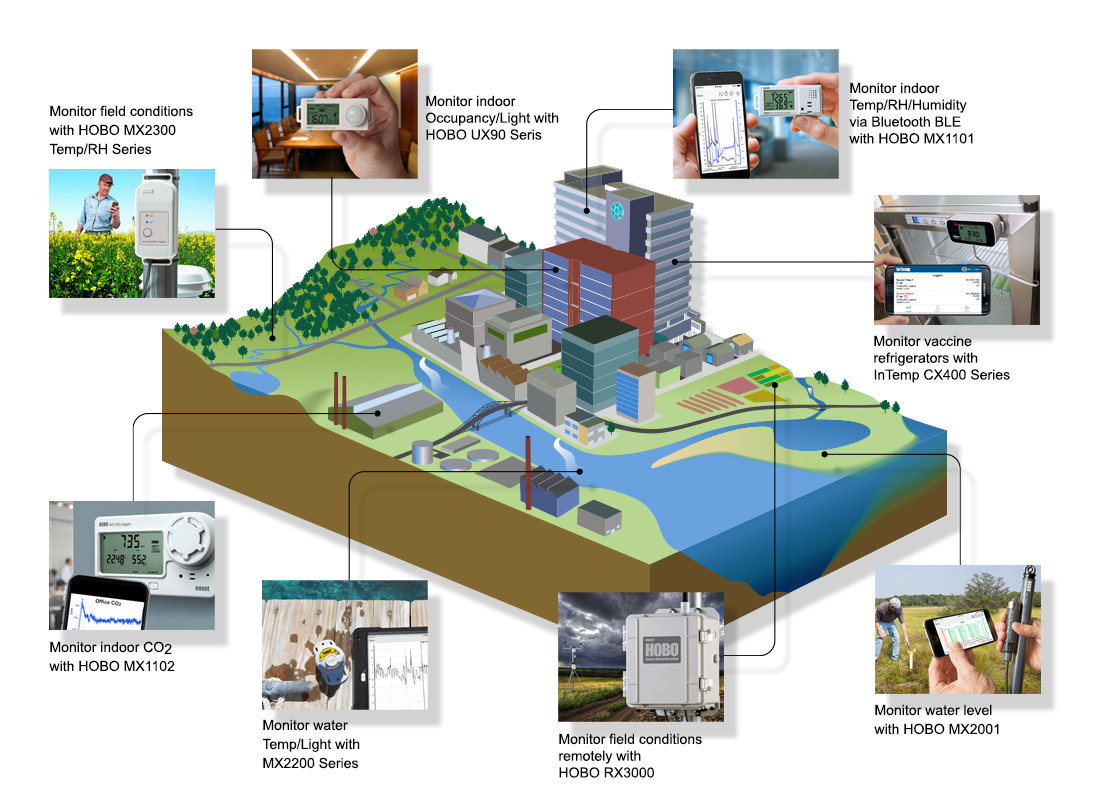
Welcome to the world of data logging!
A data logger is a compact, battery-powered device equipped with an internal microprocessor, data storage, and one or more sensors (or sensor ports) that can be deployed in a variety of environments to record measurements at set intervals for up to years at a time, unattended.
But now you may wonder, where are data loggers used and who uses them?
The environments that data loggers are used continue to grow. Used to monitor indoors, on farms to monitor soil moisture, underwater, in temperature-controlled environments for pharmaceuticals, and more, data loggers essentially measure anywhere, with the bonus of convenient features like solar and battery power and Bluetooth wireless communication.
Learn more about the basics of data logging.
So whether you’re a facility manager trying to measure and improve indoor air quality, an agricultural engineer trying to find out how to grow your crops more efficiently, or a PhD student trying to measure the effects of water level inundation on sea turtle nests, data loggers can help you.
Let’s take a closer look at the environments where data loggers are most often used:
Indoor Monitoring and Data Loggers
Did you know:
- Indoor air pollutants are ranked among the top five environmental risks to public health. Learn more about indoor air quality.
- Understanding energy consumption and loss in buildings is the first step for energy audits. Find out how data loggers can help with energy audits.
- Data Loggers can help building professionals diagnose mechanical issues, and balance healthy and comfortable interior environments with energy costs. Check out how building operators and mechanical operators use data loggers to manage HVAC/R systems.
- Invaluable historical artifacts such as the Magna Carta have NOT survived this long just by sheer luck. Learn how data loggers help museums preserve history.
_ _ _
How Data Loggers are Used for Outdoor & Water Monitoring
- Smart Farming or "Smart Ag" is transforming agriculture and often includes high-tech solutions in everyday processes. See how data loggers are leading to better practices, improved crop quality, and greater productivity for agriculture.
- Coastal areas support unique and important habitats and are often one of the first areas to be affected by climate change. Find out why coastal researchers and ecologists rely on data loggers to help manage and protect these valuable ecosystems.
- Environmental science is not just ONE discipline, it includes ecology, biology, zoology, mineralogy, oceanography, geology, physical geography, and more. All of these professionals are helping protect the environment. Find out how data loggers can be used to help these scientists study (and save) our world.
- At the most basic level, hydrology helps manage water availability and allocation (how much there is and where it goes). Since we are over 50% water ourselves and cannot go without it for more than a few days, you can understand why this is pretty important. Learn how hydrologists can use data loggers to help in their water management efforts.