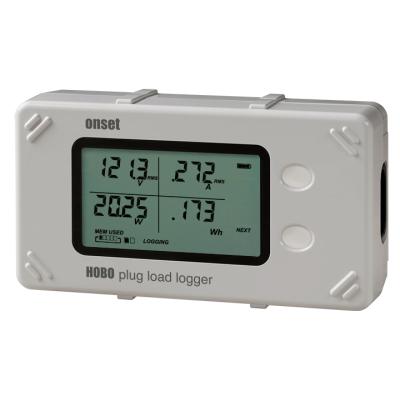
Use the tabs on this page to access basic information, detailed specifications, compatible and required items, accessories, and support.
Provides a general overview of this item including main feature set, its usage environment and measurements type(s)..
Provides detailed specifications on this item.
Use this tab to access the steps 1-3 sub-tabs below:
1. Compatible Sensors
2. Communications
3. Software
Provides a list of available accessories for this item.
If available - this tab contains links to various resources that either feature or pertain to this item, i.e. podcasts, white papers, application stories, etc.
Use this tab to access the steps 1-3 sub-tabs below:
The HOBO U12-006 accepts a wide range of energy and environmental sensors. It provides 12-bit resolution measurements for detecting greater variability in recorded data, and stores 43,000 measurements.
Features:
12-bit resolution provides high accuracy
Large memory for long-term deployments or fast sampling
Programmable and push button start
Direct USB interface for fast data offload
Compatible with Onset’s HOBO U-Shuttle for convenient data transport
Environment:
The U12-006 Data Logger is for use in Indoor environments
Measurements:
The U12-006 Data Logger supports the following measurements (some sensors sold separately): 4-20mA, AC Current, AC Voltage, Air Velocity, Carbon Dioxide, Compressed Air Flow, DC Current, DC Voltage, Gauge Pressure, Kilowatts (kW), Temperature, Volatile Organic Compound
All HOBO and StowAway data loggers shut off when the memory is full (unless wrap around is selected), or the data is downloaded to a computer. Once the data is downloaded to the computer, the data logger is in off mode and will need to be relaunched to continue data collection. If the data logger you are using is shuttle-compatible and you are downloading to a shuttle, the shuttle will automatically relaunch the data logger using the previous settings.
All U10 and U12 data loggers are fully compatible with the Real-Time Alarm Software. The data loggers can connect to a USB port on the computer or remotely through an Ethernet network using a Keyspan USB Server. HOBO Weather Station (H21) and HOBO Energy Logger (H22) data loggers connected to a serial port on the PC are also compatible. The remote communication products for HOBO® Weather Stations are not supported.
A discharge of static electricity may cause a running data logger to stop recording. Precautions should be taken to prevent this while handling the data logger. Discharges may occur in the following situations:
When there is a charge difference between the data logger and a cable being connected to it or a person touching an exposed jack.
HOBO/StowAway data loggers shut off when the memory is full (unless wrap around is selected), or the data is downloaded to a computer. Once the data is downloaded to the computer, the data logger is in off mode and will need to be relaunched to continue data collection. If the data logger you are using is shuttle-compatible and you are downloading to a shuttle, the shuttle will automatically relaunch the data logger using the previous settings.
Relaunching a logger before the data has been saved
Technical problem with the logger itself.
The following section discusses data loss and its causes; it also discusses methods of retrieving lost data, and how to insure against data-loss problems.
If possible, remove the board from the case and the battery from the board. Dry the board completely using a hair dryer. If the board was exposed to salt water, rinse the board with fresh water and then dry the board. You may try inserting a new battery and downloading the data. If you are unable to access the data, or see any sign of corrosion or tarnishing on the board, contact the place of purchase for a return number. The data may be retrievable, and the data logger may be repairable. Charges will apply and are dependent on the amount of damage.
As a general rule, no. This is dependent on the data logger you are using and the chemical and/or concentration of the chemical that the data logger is exposed to. Many chemicals will have an adverse effect on the data loggers and/or the sensors that the loggers utilize. Contact your authorized sales representative with questions regarding specific chemical contact with the data logger that you are using.
There is a small bug in early versions of the HOBO Water Temperature Pro data loggers that result in premature starting in some cases (when using the delayed-start feature). With the affected data loggers there is a 0.4% chance they will start up to 4.3 minutes early, and a 0.4% chance they will start up to 18.2 hours early. If premature delayed-start occurs, all measurements are taken at the correct sampling rate and stored with the actual times they were taken, but there will be extra readings at the beginning of the data file.
Open HOBOWare, plug the logger back in, then click on Start->Settings->Control Panel->System. Click on Hardware->Device Manager and look for the logger listed under: Other Devices or Human Interface Devices — there could be a minus sign beside one of the categories or a yellow exclamation point through the device. The description listed should indicate if it is a HOBO or not. If it is not a HOBO, do not uninstall it, as it may be another USB device. Delete the "other device," then unplug the logger, wait 15 seconds and plug it back in.
Check both the logging and the sampling interval to make sure they are greater than one-minute intervals. For example, with a sampling interval of one second, the HOBO Weather Station doesn't sleep and there is a constant drain to the batteries. Make sure that you have protected the board from condensation and insects.
The Optic and Tidbit data loggers must be inserted into the Base Station in order for the computer to detect them; it will not detect the Base Station alone. Check to make sure that the coupler is positioned properly and the magnet end is closest to the data logger, not the Base Station or the Optic Shuttle. It is important to keep the Optics and Tidbits free from obstructions such as dirt and algae. Do not use any chemicals to clean the data loggers. Clean the Optics with warm water and mild dish detergent.
No. The data is stored on non-volatile EEPROM. For data loggers with external batteries: change batteries and offload data, then relaunch normally. For data loggers with internal batteries: as long as the EEPROM has not been damaged, the data can be retrieved by Onset Computer Corp. Please contact the place of purchase for a return authorization number and request data back service.
No. These data loggers were manufactured for indoor use in non-condensing environments. Condensation will form from morning dew, temperature swings, fog, mist, and high relative humidity (RH). These data loggers are designed for indoor applications where the RH does not go above 95%.
If used outdoors unprotected, you will experience data loss and eventually damage the data logger. If placed outdoors, the data loggers need to be in a waterproof container with desiccant packs to absorb condensation that builds inside the case from temperature changes.
If the sensor is removed for more than 5 minutes while logging, the data logger will no longer recognize the sensor when it is reconnected. At that point it is necessary to relaunch the data logger in order to initialize the sensor, as the data logger will not recognize the sensor
The first and last event on your datafile is a stamp of the start and end time. For an accurate account of events, these two must be deducted from your totals.
The TL-5186 lithium batteries build up an internal passive resistance over a period of non-use. This build-up will interfere with the voltage supply to the data logger. To clear the resistance, remove the battery from the data logger and short the two battery prongs (by placing a small metal object over them), for about a half second. Place the battery back in the data logger. If the data logger is receiving power from the battery, the LED light will blink a few times rapidly upon contact. Attempt to launch the data logger again.
For input voltage to the data logger greater than 2.5 volts DC, you will need to make a voltage divider. A voltage divider will drop the voltage of the input signal to the level the data logger can measure. First determine the needed attenuation ratio; divide the input volts by the output volts to the data logger: A = input volts/2.5
A discharge of static electricity may cause a running data logger to stop recording. Precautions should be taken to prevent this while handling the data logger.
Discharges may occur in the following situations: When there is a charge difference between the data logger and a cable being connected to it or a person touching an exposed jack.
Only the TMC-HD probes are designed for prolonged submersion in water or moist soil.
The external TMC6-HA and TMC6-HB probes and the external probe on the HOBO Pro Temp/ External can be used outdoors in air and dry soil. They are not recommended for prolonged use in water or moist conditions.
They should not be used for more than 3 months total in water less then 90
The 4-20mA cable (CABLE-4-20mA) measures currents from 0 to 20.1mA. The cable must be connected such that the current flows through, and with the proper polarity, as shown in the diagram. (Do not expose to current above 20mA or negative current.) Do not cut off the end of the gray cable where it connects to the blue and yellow wires, as this contains the precision resistor required for current measurements.
The Telaire 7001 CO2 Monitor has been tested and used with the HOBO H8 and U12 family data loggers that have external sensor/voltage input capabilities. The Telaire 7001 CO2 sensor can be purchased directly from Onset computer, along with the cable (part# CABLE-Co2) that connects the sensor directly to the H8 and U12 data loggers).
The Telaire 7001 CO2 Monitor is able to monitor and display 0-10,000 ppm, on its built-in LCD screen. However, its analog voltage output only ranges from 0-4vDC (0 - 4,000 ppm).
The CO data logger should be checked, at a minimum, on a yearly basis. Proper testing requires a CO testing chamber. If you do not have access to one, you may contact the place where you purchased the HOBO CO data logger and return it for testing. If the data logger is not reading within specification, the sensor will need replacement. Please note that the sensor should not be removed from the board for more than 1-2 hours. If the sensor has been removed for a period of time, allow 24 hours from the time it is replaced for the readings to stabilize.
The TMCx-HB temperature sensors have a higher accuracy than the TMCx-HA when used with the H8s because they operate over a narrower range (i.e., accuracy is gained through improved resolution only). Because the U12s provide much better resolution (16X) over the wider range, there is no real accuracy gain by limiting the range.
Here is a description of the input impedance characteristics of the HOBO U12 data loggers with external inputs. "Rs" and "VA" in the attached diagram represent your source impedance.
Black Box Equivalent If an input channel is de-selected or when it is not measuring a voltage, that input nominally looks like 2K resistance in series with a 100pF capacitor. The leakage current may look like a nominal 5M resistance.
The maximum recommended impedance for analog sources is 2.5 K. This value is calculated based on the maximum leakage current of the input pin. The leakage current is 100 nA max., and the analog input voltage cannot be varied by more than 1/4 LSb or 250
To replace the battery unscrew the data logger case. Lift the circuit board and carefully push the battery out with a small blunt object, or pull it out with your fingernails. Insert a new battery, positive side facing up. Carfully realign the data logger case and re-fasten the screws.
All U10 and U12 data loggers are fully compatible with the Real-Time Alarm Software. The data loggers can connect to a USB port on the computer or remotely through an Ethernet network using a Keyspan USB Server. HOBO Weather Station (H21) and HOBO Energy Logger (H22) data loggers connected to a serial port on the PC are also compatible. The remote communication products for HOBO® Weather Stations are not supported.
If your Keyspan USB server has its power interrupted while you are running an alarm configuration, HOBOware will lose its connection to the data loggers attached to the server. This will cause the monitor to send a notification indicating there has been a communication failure, if you enabled communication failure notifications in the alarm configuration for the data loggers attached to the server.
For best performance, connect the USB cable directly to a port on your computer. The USB ports on your computer may be more reliable than hubs or keyboard ports.
An issue has been discovered with the database access layer, causing invalid latest conditions to be shown for U30 analog port sensors. The data in the files and graphs is correct. A fix has been implemented and is currently being tested. A release of this fix is expected in August.
A data logger (or datalogger), commonly referred to as a 'HOBO', is an electronic instrument that records measurements (temperature, relative humidity, light intensity, on/off, open/closed, voltage, pressure and events) over time. Typically, data loggers are small, battery-powered devices that are equipped with a microprocessor, data storage and sensor. Most data loggers utilize turn-key data logger software on a personal computer to initiate the logger and view the collected data.
The following are associated resources for this product. In general users of this product can gain insight into its possible use by utilizing the resources below.